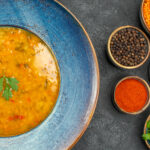
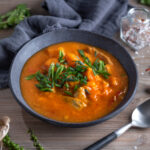
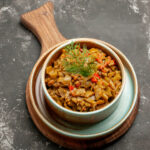
The ancient Moroccan soup of Ramadan — a velvety, warmly spiced broth of tomatoes, lentils, chickpeas, and fresh herbs thickened with a flour-and-water slurry, finished with lemon and coriander — one of the great soups of the world.
About This Recipe
Harira is the soup that breaks the Ramadan fast across Morocco, Algeria, and Tunisia every evening at Maghrib (sunset prayer) — a dish so deeply tied to the Islamic calendar that many Moroccans eat it only during Ramadan. But it is also an everyday soup, eaten year-round at lunch counters and family tables, and its reputation deserves to be understood on its own terms rather than only through its ceremonial role.
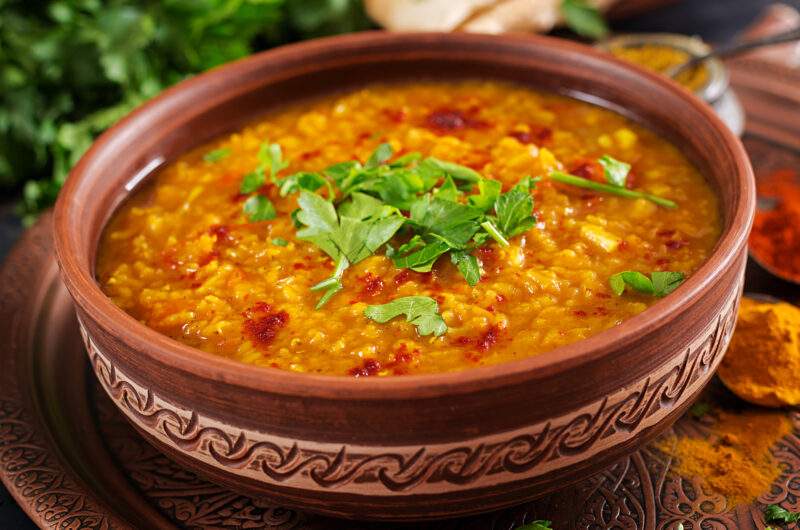
Harira is a soup of extraordinary textural complexity — simultaneously a broth, a cream soup, and a stew, its character determined by the tdouira, a paste made from flour (or occasionally broken vermicelli) whisked smooth with water and stirred into the hot soup in the final minutes of cooking. This thickening technique, unique to Moroccan and North African cooking, produces a soup that is velvety and slightly viscous rather than clear — coating the back of a spoon, warming the body with each sip, and providing the sustained energy that is needed after a day of fasting.
The base is built on caramelised onion, celery, and tomato — both fresh and tinned for depth — seasoned with the Moroccan quartet of ginger, cinnamon, pepper, and turmeric. The lentils dissolve almost entirely during cooking, contributing body and protein; the chickpeas hold their shape, providing textural contrast and additional protein. Fresh coriander and flat-leaf parsley are added in large quantities both during cooking and at serving — their green brightness cutting through the richness of the spiced tomato base and providing the freshness that defines a well-made harira. A final squeeze of lemon just before serving, combined with a drizzle of good olive oil, completes the bowl.
History & Origins
Harira has been prepared in Morocco for centuries, with references in Moroccan culinary texts dating to the 12th century. The dish’s association with Ramadan is documented from at least the 14th century, when Moroccan scholars described the ritual of breaking the fast with harira, dates, and chebakia (honey pastries). The specific combination of tomato — introduced to Morocco from the Americas only in the 16th century — with the pre-existing spice and herb base suggests the dish evolved significantly after European contact, though its essential character is ancient. Harira is considered a UNESCO cultural heritage food of Morocco.
Why It’s Healthy
Harira delivers one of the most comprehensive nutritional profiles of any soup. Lentils provide complete protein when combined with the chickpeas (together providing all essential amino acids), along with exceptional quantities of fibre, iron, and folate. Chickpeas add resistant starch supporting gut microbiome health. Tomatoes provide lycopene — concentrated and made more bioavailable by the long cooking time. Ginger contains gingerols and shogaols with anti-nausea, anti-inflammatory, and digestive benefits. Cinnamon has documented blood glucose-regulating properties in multiple clinical trials. The combination makes harira one of the most nutritionally dense low-calorie soups in any tradition.
Moroccan Harira
Course: Healthy6
servings15
minutes50
minutes1770
kcalIngredients
•t150g red or green lentils, rinsed
•t400g tin chickpeas, drained and rinsed
•t400g tin crushed tomatoes
•t3 medium fresh tomatoes, diced
•t2 celery stalks with leaves, finely diced
•t1 large onion, finely diced
•t4 garlic cloves, minced
•tLarge bunch fresh coriander, roughly chopped (keep stalks separate)
•tLarge bunch flat-leaf parsley, roughly chopped
•t3 tbsp olive oil
•t1 tsp ground ginger
•t1 tsp ground cinnamon
•t0.5 tsp turmeric
•t0.5 tsp black pepper
•t1.5 litres water or vegetable broth
•tFor tdouira: 2 tbsp plain flour whisked with 100ml cold water
•tJuice of 1 lemon
•tSalt to taste
Directions
- Heat olive oil in a large pot. Sauté onion, celery, and coriander stalks for 8 minutes until softened.
- Add garlic, ginger, cinnamon, turmeric, and black pepper. Cook 2 minutes.
- Add fresh tomatoes, tinned tomatoes, lentils, and half the coriander. Stir well.
- Add water or broth. Bring to a boil, then reduce to a simmer.
- Cook uncovered for 25–30 minutes until lentils are completely soft.
- Add chickpeas and cook for 10 more minutes.
- Whisk flour and water together until completely smooth (tdouira). Stir into the simmering soup.
- Cook for 5–8 minutes, stirring frequently, until the soup thickens to a velvety consistency.
- Add lemon juice, remaining coriander, and parsley. Season generously with salt.
- Serve immediately with extra lemon on the side.
Notes
- The tdouira (flour slurry) must be completely smooth before adding — whisk vigorously with cold water. Lumps in the thickener produce an unpleasant texture.
Stir the soup constantly after adding the tdouira to prevent it from sinking and scorching on the bottom.
Harira should be quite thick — it is not a clear broth but a velvety, substantial soup. Add more water only if it becomes too stiff to pour.
For a gluten-free version, substitute the flour thickener with 2 tablespoons of ground almonds or rice flour — the texture is slightly different but delicious
- The tdouira (flour slurry) must be completely smooth before adding — whisk vigorously with cold water. Lumps in the thickener produce an unpleasant texture.
- Stir the soup constantly after adding the tdouira to prevent it from sinking and scorching on the bottom.
- Harira should be quite thick — it is not a clear broth but a velvety, substantial soup. Add more water only if it becomes too stiff to pour.
For a gluten-free version, substitute the flour thickener with 2 tablespoons of ground almonds or rice flour — the texture is slightly different but delicious