Hungary’s beloved summer vegetable stew of sweet peppers, ripe tomatoes, and smoked paprika — a deeply flavoured, glistening base that is eaten alone, with eggs, or as the foundation of half of Hungarian cooking.
About This Recipe
Lecsó is the beating heart of Hungarian summer cooking — a preparation so versatile, so fundamental, and so deeply embedded in Hungarian food culture that calling it merely a recipe undersells what it actually is. Lecsó is a concept, a technique, and a pantry staple all at once. Made in enormous batches during the late summer pepper harvest and preserved in jars for the winter, it forms the base of countless Hungarian dishes throughout the year: added to goulash, stirred into scrambled eggs, used as a pasta sauce, spooned over grilled sausage, or simply eaten alone with bread as a complete summer meal.
The dish requires only three ingredients plus fat and seasoning — peppers, tomatoes, and onion — but the quality of those three ingredients determines everything. Hungarian white and yellow sweet peppers (fehér and sárga paprika) are the traditional choice, with a thin skin that softens completely during cooking and a distinctive flavour that is sweeter and more complex than bell peppers. During late summer, when Hungarian markets overflow with these peppers, lecsó reaches its peak. In the absence of Hungarian peppers, a combination of sweet red bell peppers, yellow peppers, and a few Italian frying peppers approximates the flavour profile adequately.
The technique is patience: the peppers and onion must be cooked gently until completely soft and yielding, releasing their natural sugars into the fat, before the tomatoes are added. The smoked paprika — sweet rather than hot in the classic version — provides the characteristic deep red colour and the distinctive Hungarian flavour that separates lecsó from the similar Italian peperonata or Spanish pisto. A generous amount of lard or goose fat is traditional; olive oil produces a lighter, less authentically Hungarian but perfectly delicious result.
History & Origins
Lecsó appears in Hungarian culinary records from the late 18th century, following the widespread adoption of the capsicum pepper into Central European cooking after its introduction from the Americas via Ottoman trade routes in the 16th century. Hungary developed an exceptionally sophisticated pepper culture — producing dozens of varieties bred specifically for culinary use, developing a smoked paprika tradition unrivalled in Europe, and making peppers the central element of their national cuisine in a way that is unique in the European context. Lecsó is the dish that most directly expresses this central relationship between Hungarian culture and the pepper.
Why It’s Healthy
Sweet peppers are among the richest food sources of vitamin C in the human diet — a single serving of lecsó provides more vitamin C than an equivalent serving of citrus fruit. Red peppers specifically contain the highest concentrations of lycopene and beta-carotene among common vegetables. Tomatoes contribute additional lycopene, the bioavailability of which is significantly increased by cooking in fat — making lecsó a nutritional delivery system for this anti-cancer antioxidant. Smoked paprika provides capsanthin and other carotenoids. The dish is naturally vegan, gluten-free, and low in calories while being deeply satisfying.
Hungarian Lecsó
4
servings15
minutes45
minutes740
kcalIngredients
•t6 sweet peppers (mixed yellow, red, and orange), thinly sliced
•t400g ripe tomatoes, diced (or 400g tin peeled tomatoes)
•t2 large onions, thinly sliced
•t3 garlic cloves, minced
•t2 tbsp lard, goose fat, or olive oil
•t1.5 tbsp sweet smoked Hungarian paprika
•t0.5 tsp hot paprika (to taste)
•t1 tsp sugar
•tSalt and black pepper to taste
•tOptional: 4 eggs, fresh dill, smoked sausage (kolbász)
Directions
- Heat fat in a wide, heavy pan over medium heat. Add onion and cook for 10 minutes until deeply softened and beginning to colour.
- Add garlic and sliced peppers. Stir to coat in the fat.
- Cook uncovered over medium-low heat for 15–20 minutes, stirring occasionally, until peppers are completely soft and beginning to collapse.
- Add sweet paprika and hot paprika. Stir through for 1 minute.
- Add tomatoes and sugar. Stir to combine.
- Cook uncovered for a further 15–20 minutes until the mixture is thick, glossy, and the oil has separated slightly on the surface.
- Season with salt and pepper. For egg lecsó, create wells and poach eggs directly in the stew for 6–8 minutes covered.
Notes
- Smoked sweet Hungarian paprika is the defining flavour — regular paprika produces a flat result. Seek out Hungarian or Spanish smoked sweet paprika at a good deli or online.
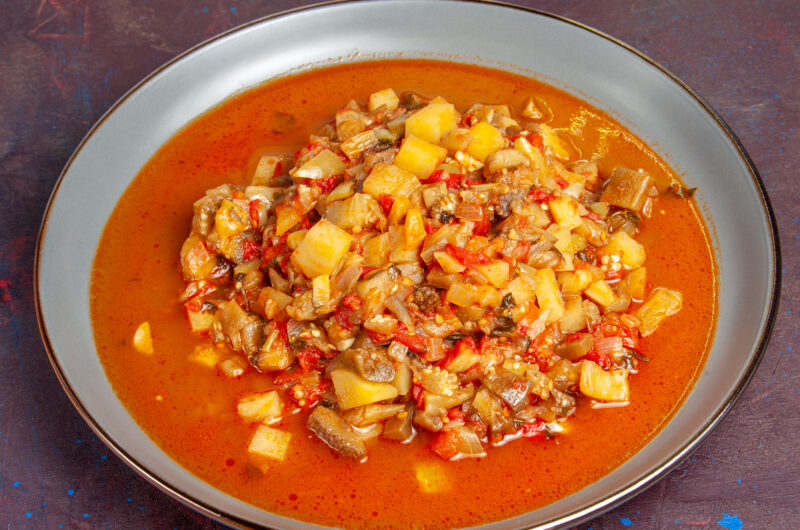
The lecsó is ready when it looks like a glistening, thick, jewel-like relish rather than a soupy stew — the moisture should be mostly cooked off.
Lard produces the most authentically Hungarian flavour. For a lighter, modern version, good olive oil works excellently.
Lecsó can be preserved: pour boiling hot lecsó into sterilised jars, seal immediately, and process in a water bath for 20 minutes. Store in a cool dark place for up to 1 year.
Make Ahead Tips
Lecsó is one of the ultimate make-ahead dishes and is traditionally made in large batches specifically for storage. Make double or triple the recipe — it keeps in the fridge for 1 week and freezes for 6 months. Cold lecsó from the fridge is excellent on bread like a relish. Reheated lecsó is the base for egg lecsó, pasta sauce, or a side for grilled meats. The investment of making a large batch pays dividends all week.
Storage & Serving
Lecsó keeps in the fridge for up to 7 days and freezes beautifully for 6 months — making it one of the most useful batch-cooking preparations in this collection. Reheat gently in a pan until bubbling. It thickens further in the fridge and may need a splash of water when reheating. For egg lecsó, always add eggs fresh to the reheated base rather than storing the egg version. Properly sealed jarred lecsó keeps at room temperature for up to 1 year. Serve lecsó at the centre of the table with thick slices of fresh white Hungarian bread (or any crusty white bread) alongside. As egg lecsó (tojásos lecsó), serve with bread for mopping. For a more substantial meal, add sliced smoked kolbász sausage fried briefly in the pan before the onions, or lay slices over the finished stew. A cold glass of Hungarian Furmint white wine or a chilled Dreher lager alongside is traditional.
Variations & Substitutions
Add 200g of sliced smoked kolbász or chorizo to the base for a rich, meaty main course version. Stir in 2 tablespoons of sour cream at the end for a creamier, richer result that is popular in restaurant versions. A Serbian djuveč uses the same base ingredients with the addition of rice cooked directly in the stew, plus aubergine, courgette, and green beans for a more substantial, almost risotto-like dish. Italian peperonata is essentially lecsó without the smoked paprika — the comparison shows how central the paprika is to the Hungarian identity of the dish.