Eggs poached in a deeply spiced tomato and red pepper sauce, crowned with crumbled feta, fresh herbs, and chilli flakes — the great communal breakfast of the Middle East, gloriously simple and endlessly satisfying.
About This Recipe
Shakshuka has become one of the most globally adopted dishes of the past two decades, exported from Israeli café culture to brunch menus on every continent with a speed that speaks to its universal appeal. But familiarity should not be allowed to make it routine — made with care, this is an extraordinary dish, and the difference between a shakshuka made hastily and one made with proper attention is enormous.
The sauce is everything. It must be cooked long enough for the tomatoes to break down completely and lose all their watery rawness, for the peppers to become silk-soft, and for the spices to fully integrate into the base. This takes 20–25 minutes, not the 10 minutes that the impatient version allows. The cumin, smoked paprika, and a pinch of cinnamon provide the warm spice backbone; the harissa adds heat and depth; the tinned tomatoes provide the body. The sauce should be thick enough that a spoon drawn through it leaves a clear channel that closes slowly.
The eggs are the technical challenge. They must be cooked to the exact point where the whites are fully set and opaque but the yolks remain entirely runny — the liquid yolk breaking over the sauce when eaten is the defining pleasure of the dish. This requires wells deep enough in the sauce that the whites are supported and the eggs cook evenly from all sides. The pan must be covered after the eggs are added, using the trapped steam to cook the tops of the whites without overcooking the yolks. A glass lid makes monitoring the progress effortless; a conventional lid requires vigilance and frequent checking.
History & Origins
The origins of shakshuka are contested between Tunisia, Libya, Morocco, and other North African countries, where versions of eggs cooked in spiced tomato sauce have been made for centuries. The dish was brought to Israel by Jewish immigrants from North Africa and Yemen in the early 20th century, where it was adopted into Israeli cuisine so thoroughly that it is now claimed as a national dish. Today it is eaten across the Middle East and North Africa under various names and with regional variations, but the Israeli café version — with feta, fresh herbs, and often served in the pan — is the most internationally recognised form.
Why It’s Healthy
Shakshuka delivers an impressive nutritional profile in a single pan. Eggs provide complete protein, choline for brain health, lutein and zeaxanthin for eye health, and fat-soluble vitamins A, D, and E. The tomato base is rich in lycopene — a potent antioxidant that is actually more bioavailable cooked than raw and is associated with reduced risk of prostate and other cancers. Red peppers are one of the highest food sources of vitamin C. Harissa contains capsaicin and capsanthin. Feta provides calcium and protein. The dish is naturally gluten-free and can be made dairy-free.
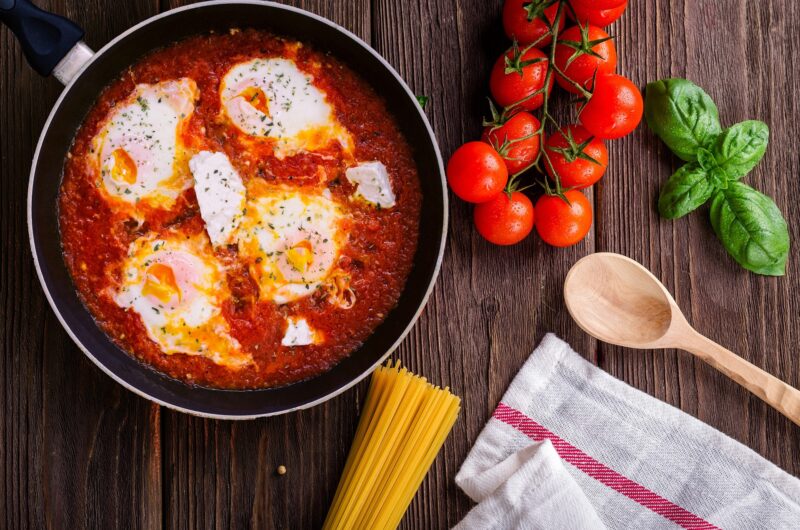
Israeli Shakshuka with Feta and Herbs
4
servings10
minutes35
minutes310
kcalIngredients
•t4 large eggs
•t2 x 400g tins whole peeled tomatoes
•t2 red peppers, diced
•t1 large onion, diced
•t4 garlic cloves, minced
•t2 tbsp harissa paste
•t1.5 tsp ground cumin
•t1 tsp smoked paprika
•t0.5 tsp ground coriander
•tPinch of cinnamon
•t2 tbsp olive oil
•t80g feta cheese, crumbled
•tFresh flat-leaf parsley and fresh mint to garnish
•tSalt, black pepper, dried chilli flakes to taste
Directions
- Heat olive oil in a wide, lidded pan over medium heat. Add onion and cook for 8 minutes until softened.
- Add red peppers and cook for 5 minutes until tender.
- Add garlic, cumin, smoked paprika, coriander, and cinnamon. Cook 2 minutes until fragrant.
- Add harissa and stir through.
- Add tinned tomatoes, crushing them with a spoon. Stir to combine. Season generously with salt and pepper.
- Simmer uncovered for 15–20 minutes, stirring occasionally, until sauce is thick and rich.
- Taste and adjust seasoning. Create 4 deep wells in the sauce with the back of a spoon.
- Crack one egg into each well. Crumble feta generously over the entire surface.
- Cover with a lid and cook on medium-low for 6–8 minutes until whites are set but yolks are still runny.
- 10.tScatter fresh herbs and chilli flakes over. Serve immediately from the pan.
- Notes
Notes
- Room temperature eggs cook more evenly than cold eggs — remove from the fridge 20 minutes before cooking.
Do not skip the 15–20 minutes of sauce simmering. Underdeveloped sauce produces a watery, flat-tasting shakshuka.
The eggs continue to cook after the pan is removed from the heat — take it off 30 seconds before the yolks look done.
A cast-iron or heavy enamelled pan retains heat better than a regular pan, producing more even cooking around the eggs.
Make Ahead Tips
The tomato sauce base is the most time-consuming component and can be made 3 days in advance. Cooled and refrigerated, it actually develops more flavour overnight. Reheat the sauce gently in the pan until fully hot and bubbling before adding the eggs, which must always be cooked to order — pre-cooked eggs in shakshuka are unpleasant. Making the sauce ahead turns this into a 10-minute meal.
Storage
The tomato sauce keeps in the fridge for up to 5 days and freezes well for 3 months — making it one of the most versatile components in this book, useful not only for shakshuka but as a pasta sauce, pizza base, or braising liquid for fish. Cooked shakshuka with eggs does not store well — the eggs overcook on reheating and the texture becomes rubbery. Always cook eggs fresh in reheated sauce.
Serving Tips
Serve directly from the pan placed in the centre of the table with warm flatbread or crusty sourdough for scooping — this is a communal dish and should be eaten in the pan. A simple Israeli salad of diced tomato, cucumber, and parsley alongside, and labneh (strained yoghurt) for dolloping on top, complete the traditional accompaniments. Strong black coffee or fresh mint tea are the natural drinks.
Variations & Substitutions
Green shakshuka (shakshuka verde) uses tomatillos, green peppers, and spinach instead of red tomatoes for a completely different flavour profile. Add merguez sausage or lamb mince browned in the pan before adding the onion for a heartier, meat-based version. A handful of spinach or baby kale stirred into the sauce before adding the eggs adds extra nutrition and turns the sauce a beautiful jewel green at the edges. Replacing feta with labneh or ricotta gives a creamier, milder result.