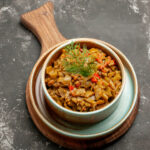
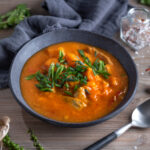
The legendary Tuscan peasant soup — thick with cannellini beans, cavolo nero, and day-old bread that dissolves into a hearty, deeply savoury broth that improves with every reheat.
Ribollita — the name means ‘reboiled’ — is one of the most celebrated peasant dishes in the Italian culinary canon, born of the Tuscan tradition of never wasting food, particularly bread. It is a soup that starts well and becomes extraordinary with time: made on one day, reheated (reboiled, as the name suggests) the next, and further improved on the day after that, when the bread has fully dissolved and the flavours have had sufficient time to marry into something truly unified.
The foundation of great ribollita is cavolo nero — the dark, almost black Tuscan kale whose long, crinkled leaves have a robust, mineral quality that holds up to extended cooking where other greens would collapse into bitterness. Cannellini beans, cooked from dried if time permits, provide the creamy, starchy body that makes this soup as filling as a stew. Roughly half the beans are mashed or blended and returned to the pot, thickening the broth to the characteristic dense, porridge-like consistency that makes ribollita unmistakable.
The bread — ideally a dense, unsalted Tuscan pane sciocco, though any good stale sourdough will do — is added in torn pieces to the soup and cooked until fully absorbed, creating a texture that is quite unlike any other soup in the European tradition. A generous drizzle of grassy, peppery Tuscan extra-virgin olive oil at serving is not optional — it provides the finishing richness that ties the whole dish together.
Calories: 380 kcal | Protein: 16g | Carbs: 58g | Fat: 9g | Fiber: 14g
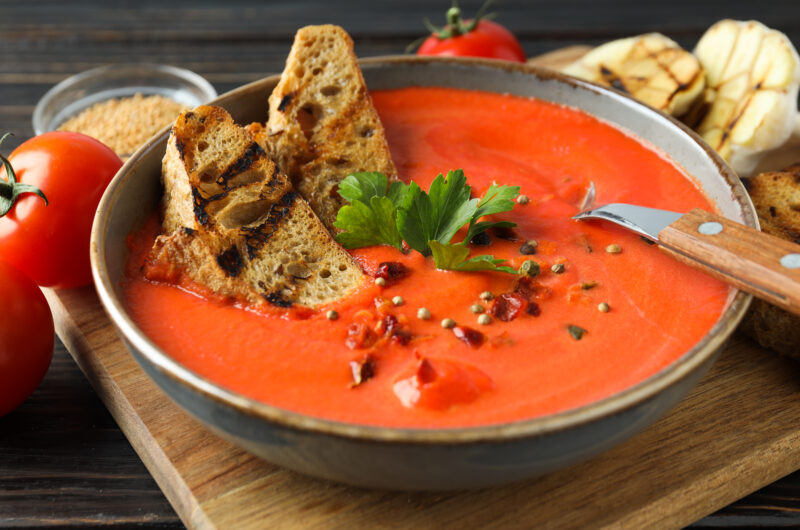
Italian Ribollita
6
servings20
minutes1
hour380
kcalIngredients
•t2 x 400g tins cannellini beans, drained
•t200g cavolo nero (Tuscan kale), stems removed, leaves roughly chopped
•t200g savoy cabbage, roughly chopped
•t300g stale sourdough bread, torn into pieces
•t2 celery stalks, diced
•t2 carrots, diced
•t1 large onion, diced
•t4 garlic cloves, minced
•t400g tin whole peeled tomatoes
•t1.2 litres vegetable broth
•t4 tbsp extra-virgin olive oil, plus more to serve
•t2 sprigs fresh rosemary
•t1 tsp dried thyme
•tSalt and black pepper to taste
•tParmesan rind (optional, add if not vegan)
Directions
- Heat 3 tbsp olive oil in a large pot over medium heat. Add onion, celery, and carrot and cook for 10 minutes until softened.
- Add garlic, rosemary, and thyme. Cook for 2 minutes.
- Add tomatoes, crushing them with a spoon. Cook for 5 minutes.
- Add beans, broth, and Parmesan rind if using. Bring to a simmer and cook for 15 minutes.
- Remove half the beans with a slotted spoon and mash roughly, or blend briefly. Return to the pot.
- Add cavolo nero and cabbage. Simmer for 15 minutes until tender.
- Add torn bread and stir well. Cook for a further 15 minutes until bread has broken down and the soup is very thick.
- Season generously with salt and pepper. Serve with a drizzle of good extra-virgin olive oil.
Notes
- Do not use fresh bread — it will disintegrate rather than absorb. Stale or oven-dried bread is essential.
The texture should be very thick — closer to a stew or porridge than a conventional soup. If it seems too thick, add a splash of hot water.
Ribollita genuinely improves on the second and third day — make a large batch and look forward to it getting better.
Cavolo nero can be found at farmers markets and well-stocked supermarkets in autumn and winter. Regular kale is an acceptable substitute but lacks the distinctive mineral quality of cavolo nero.
Storage
Ribollita is one of the best soups for storage and actually improves with time, as the name suggests. It keeps in the fridge for up to 5 days and freezes well for up to 3 months. Reheat over medium heat with a splash of broth or water, stirring frequently — it will have thickened considerably overnight. A fresh drizzle of good olive oil over each portion when serving restores the richness lost during storage.
Serving Tips
Serve in deep bowls with a generous pour of peppery Tuscan extra-virgin olive oil over the top — do not be shy, this is the finishing element that makes the dish. A final twist of black pepper, a scattering of fresh parsley, and thick slices of toasted bread alongside complete the table. Red wine, ideally a Chianti or Morellino di Scansano, is the natural accompaniment.