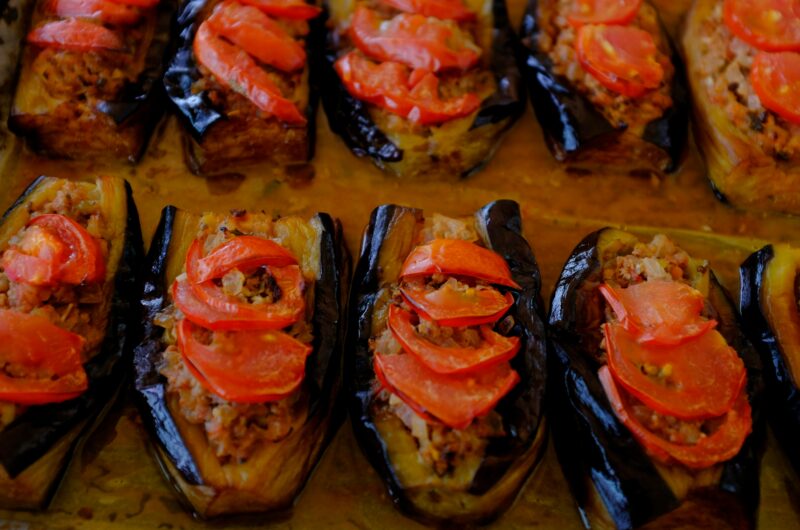
The legendary Ottoman aubergine dish — split and stuffed with a fragrant mixture of caramelised onion, tomato, garlic, and parsley, then braised in generous olive oil until completely tender and silky — a masterpiece of vegetable cooking.
About This Recipe
The name imam bayildi means ‘the imam fainted’ in Turkish — a title whose origin is contested between those who claim the imam fainted from the heavenly pleasure of eating the dish and those who claim he fainted at the extravagant amount of olive oil used in its preparation. Both explanations illuminate something true about the dish: it is both extraordinarily delicious and genuinely, gloriously oily in the way that only the best olive oil dishes can be.
Iman bayildi belongs to the category of Turkish dishes called zeytinyağlılar — ‘olive oil dishes’ — a group of preparations that are cooked entirely in olive oil, served at room temperature, and represent some of the most sophisticated vegetable cookery in the world. The technique is both simple and precise: the aubergines are partially slit and salted to draw out bitterness, then fried briefly in olive oil before being stuffed and braised in a mixture of olive oil, water, and the stuffing liquid until the flesh becomes completely yielding, almost translucent, and the surrounding liquid reduces to a fragrant, tomatoey olive oil sauce.
The stuffing is the key: onion must be cooked until genuinely sweet and golden, not merely softened; the tomatoes must be ripe and flavourful; the garlic must be sliced rather than minced so it retains its identity in the finished dish; the parsley must be added in generous quantity at the end rather than cooked through. The resulting stuffed aubergines, served at room temperature, are one of the most elegant expressions of Mediterranean vegetable cooking — deeply savoury, rich with olive oil, sweet with long-cooked onion and tomato, and possessed of an aubergine silkiness that only extended braising achieves.
History & Origins
Imam bayildi appears in Ottoman culinary manuscripts from at least the 18th century, though its origins may be older. It belongs to the Ottoman palace cooking tradition of Topkapı, where hundreds of aubergine preparations were recorded, reflecting the Ottoman Empire’s famous reverence for the aubergine — reportedly the favourite vegetable of the sultans. The zeytinyağlı cooking tradition spread across the former Ottoman territories, and versions of imam bayildi are found today in Greece (where it is called papoutsakia), the Balkans, and the Arab world, each with regional variations. The Turkish original remains the most refined version.
Why It’s Healthy
Aubergine is one of the most antioxidant-rich vegetables available, with particularly high concentrations of nasunin — a potent anthocyanin found in the skin that protects cell membranes from oxidative damage and has been shown to have neuroprotective properties. The cooking process with olive oil actually increases the bioavailability of these antioxidants. Olive oil itself provides oleic acid and oleocanthal, the latter having anti-inflammatory properties comparable to low-dose ibuprofen. Garlic provides allicin and quercetin. Tomatoes provide lycopene. The dish is naturally vegan, gluten-free, and rich in fibre while providing a broad spectrum of anti-inflammatory polyphenols.
Stuffed Aubergine in Olive Oil
Course: Healthy4
servings50
minutes1
hour1180
kcalIngredients
•t4 medium aubergines
•t3 large onions, thinly sliced
•t6 garlic cloves, thinly sliced
•t4 medium tomatoes, diced (or 400g tin crushed tomatoes)
•tLarge bunch flat-leaf parsley, roughly chopped
•t150ml extra-virgin olive oil, divided
•t1 tsp sugar
•tJuice of half a lemon
•tSalt and black pepper to taste
•t150ml water
Directions
- Cut a deep lengthwise slit in each aubergine without cutting through the ends. Salt generously inside the slits and set aside for 30 minutes.
- Heat 4 tbsp olive oil in a wide pan. Fry onions over medium heat for 15–20 minutes until deeply golden and sweet.
- Add sliced garlic and cook 3 minutes. Add tomatoes, sugar, salt, and pepper. Cook for 10 minutes until thick.
- Remove from heat and stir in half the parsley.
- Rinse aubergines and pat dry. Heat 4 tbsp olive oil in an oven-safe dish over medium-high heat.
- Fry aubergines on all sides for about 5 minutes until lightly golden. Remove from heat.
- Gently prise open the slits and fill each aubergine generously with the onion-tomato stuffing.
- Pour remaining olive oil and water around the aubergines. Cover tightly with foil.
- Braise at 180°C for 40–45 minutes until aubergines are completely soft and yielding.
- Cool to room temperature. Scatter remaining parsley over. Serve at room temperature.
Notes
- Imam bayildi is always served at room temperature, never hot — this is not a compromise but the intended serving temperature, at which the flavours are fullest.
The generous quantity of olive oil is integral to the dish — do not reduce it significantly or the aubergines will be dry and the dish will lack its characteristic richness.
Salting the aubergines is still worthwhile even with modern, less bitter varieties — it draws out moisture and improves the texture of the finished dish.
The dish improves enormously overnight as the aubergines continue to absorb the olive oil and tomato sauce — make it a day ahead for the best result.
Make Ahead Tips
Imam bayildi is one of the ultimate make-ahead dishes — it must be made at least several hours in advance to reach room temperature, and is significantly better made the day before serving. The flavour develops as the aubergines cool and absorb the olive oil-tomato sauce. Make 24 hours in advance, refrigerate covered, and bring to room temperature 1 hour before serving. Do not reheat — the dish is intended to be eaten at room temperature.
Storage & Serving
Imam bayildi keeps in the fridge for up to 5 days, becoming richer and more deeply flavoured with each day of storage. Always serve at room temperature — remove from the fridge at least 45 minutes before eating. The olive oil will solidify in the fridge, which is normal; it will liquify again as the dish comes to room temperature. Do not freeze — the aubergine texture becomes watery and unpleasant on thawing. Serve on a large platter with the cooking juices spooned over, a final drizzle of good olive oil, and the remaining parsley scattered over. Warm crusty bread or pide (Turkish flatbread) for mopping up the extraordinary olive oil sauce is essential. As part of a meze spread, imam bayildi sits alongside hummus, tabbouleh, stuffed grape leaves, and labneh. A glass of chilled Turkish raki or cold ayran (yoghurt drink) alongside is traditional.
Variations & Substitutions
Karnıyarık is the meat-stuffed cousin of imam bayildi — the same preparation with spiced lamb and pine nut stuffing instead of the vegetarian filling. Add 50g of toasted pine nuts and 50g of currants to the stuffing for a sweeter, more complex filling that is particularly good with the tomato. A Greek papoutsakia version tops the stuffed aubergine with béchamel sauce and bakes it under the grill until golden — a richer, more substantial dish. Replace some of the tomato with roasted red peppers for a smokier, sweeter stuffing.