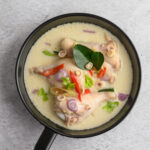
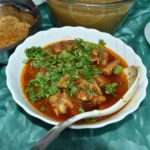
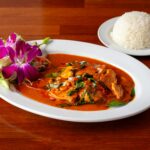
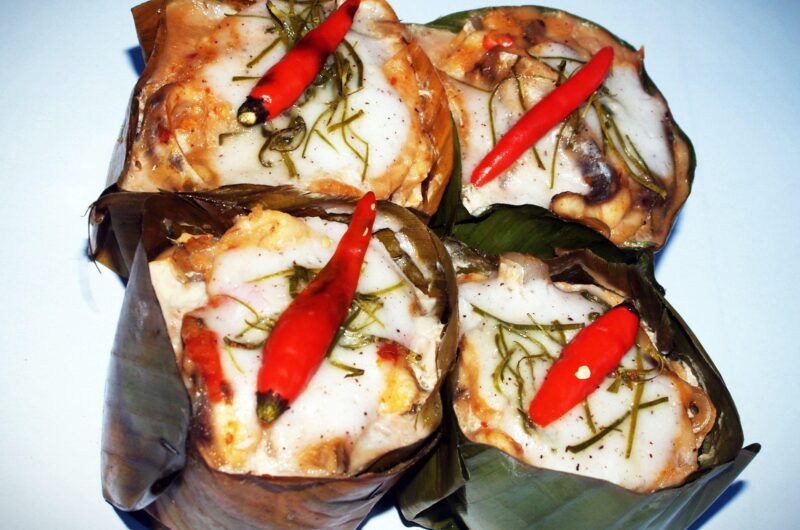
A silky, fragrant Cambodian steamed fish curry wrapped in banana leaf — coconut milk enriched with lemongrass, galangal, and kaffir lime, thickened with eggs into a delicate, cloud-like custard that is one of Southeast Asia’s most refined dishes.
About This Recipe
Fish amok is considered the national dish of Cambodia — a preparation of such elegance and cultural significance that it is served at state banquets and festive occasions across the country. It is not, strictly speaking, a curry in the way most people understand the word: it is a steamed custard, enriched with coconut cream and thickened by eggs into a texture that is simultaneously firm and silky, fragrant and gentle. The experience of eating it is unlike anything else in Southeast Asian cooking.
The foundation is the kroeung — the Cambodian spice paste that is as essential to Cambodian cooking as mirepoix is to French cuisine. Made from lemongrass, galangal, kaffir lime leaves and zest, fresh turmeric, shallots, garlic, and dried chillies, it is pounded in a mortar until completely smooth, a process that takes 15–20 minutes of committed work but produces a paste of extraordinary fragrance that no blender can fully replicate. The lemongrass must be bruised and sliced before pounding; the galangal must be very finely chopped first; the kaffir lime zest grated directly into the mortar. The resulting paste is bright yellow-green, intensely aromatic, and the flavour backbone of the entire dish.
The fish — traditionally a freshwater fish such as snakehead, though any firm white fish works well — is cut into pieces, coated in the kroeung mixed with coconut cream, fish sauce, and palm sugar, then folded with beaten eggs to create the custard mixture. Steaming rather than simmering is what gives amok its character: the gentle, even heat of steam sets the custard without curdling it, producing a texture that is impossible to achieve by any other method. Banana leaf cups are traditional and add a subtle, grassy fragrance to the finished dish.
History & Origins
Amok trey appears in Cambodian royal court records dating to the Angkor period (9th–15th centuries), when it was prepared as a ceremonial dish for the Khmer kings. The dish survived the catastrophic Khmer Rouge period (1975–1979), when much of Cambodia’s culinary knowledge was deliberately destroyed, largely through the memory of the diaspora and the determination of surviving cooks to preserve their food culture. Its revival in the 1990s and 2000s is considered a symbol of Cambodian cultural resilience and national identity.
Why It’s Healthy
White fish is one of the leanest, highest-protein foods available — a serving provides approximately 30g of complete protein with minimal saturated fat. Coconut cream, while calorically dense, contains medium-chain triglycerides (MCTs) that are metabolised differently from other fats and have been associated with increased satiety and metabolic rate. The kroeung spice paste is extraordinarily rich in bioactive compounds: galangal contains galangin with anti-inflammatory and anti-cancer properties; turmeric provides curcumin; lemongrass contains citral and limonene. Kaffir lime leaf contains high concentrations of antioxidant flavonoids.
Steamed Fish Curry
Course: Healthy4
servings20
minutes40
minutes1480
kcalIngredients
•t600g firm white fish fillets (cod, snapper, or tilapia), cut into 4cm pieces
•t400ml coconut cream
•t2 eggs, beaten
•t2 tbsp fish sauce
•t1 tsp palm sugar or brown sugar
•tFor kroeung paste: 3 stalks lemongrass, inner part only, finely sliced
•tFor kroeung paste: 3cm piece galangal, finely chopped
•tFor kroeung paste: 4 kaffir lime leaves, central rib removed, finely chopped
•tFor kroeung paste: 1 tsp fresh turmeric or 0.5 tsp ground
•tFor kroeung paste: 4 shallots, roughly chopped
•tFor kroeung paste: 4 garlic cloves
•tFor kroeung paste: 2 dried red chillies, soaked
•tTo serve: extra kaffir lime leaves, sliced red chilli, jasmine rice
Directions
- Make the kroeung: pound all paste ingredients together in a mortar, working from hardest to softest, until completely smooth — about 15 minutes. Alternatively blend with a splash of coconut cream.
- Combine kroeung paste with 300ml coconut cream, fish sauce, and palm sugar. Stir until smooth.
- Fold in beaten eggs gently — do not whisk vigorously or you will create air bubbles.
- Add fish pieces and turn gently to coat.
- If using banana leaf cups, form into bowls and secure with toothpicks. Alternatively use small ramekins.
- Divide fish mixture among cups or ramekins. Spoon remaining coconut cream over the top.
- Steam over vigorously boiling water for 15–18 minutes until the custard is just set — it should wobble slightly but not be liquid.
- Garnish with thinly sliced kaffir lime leaves and red chilli. Serve with steamed jasmine rice.
Notes
- The custard is set when it no longer wobbles like liquid at the centre — a slight tremor is perfect. Overcooked amok becomes grainy and dense.
If using banana leaves, briefly pass them over a gas flame or dip in hot water to make them pliable before forming into cups.
The kroeung paste can be blended rather than pounded — the texture will be less perfect but the flavour nearly as good.
Galangal is not a substitute for ginger — the flavours are completely different. Galangal is available at Asian supermarkets.
Make Ahead Tips
The kroeung paste can be made up to 5 days in advance and stored in the fridge, or frozen in tablespoon portions for up to 3 months. This is the most time-consuming step, and making it ahead transforms amok into an achievable weeknight dish. The coconut custard mixture (without the fish) can be made the morning of serving and refrigerated. Assemble and steam just before eating.
Storage & Serving
Cooked amok keeps in the fridge for up to 2 days. Reheat gently in a steamer for 5 minutes or in a low oven (150°C) covered with foil for 8 minutes — do not microwave, as the custard texture is very sensitive to uneven heat. The kroeung paste keeps refrigerated for 5 days or frozen for 3 months. Do not freeze the cooked custard — it separates on thawing. Serve in the banana leaf cups or ramekins placed directly on each plate, alongside a bowl of jasmine rice. A simple Cambodian cucumber salad (thinly sliced cucumber with rice vinegar, sugar, and chilli) provides freshness and acidity to balance the rich custard. A wedge of lime on the side and extra chilli for those who want more heat complete the plate.
Variations & Substitutions
Chicken amok uses the same custard technique with thinly sliced chicken thigh — a popular variation that is equally delicious. A fully vegetarian version with firm tofu or young jackfruit is widely made and works remarkably well with the kroeung paste. Some modern interpretations add a tablespoon of peanut butter to the coconut cream for a richer, nuttier flavour profile. In Phnom Penh restaurants, amok is sometimes made with prawns or crab for an even more celebratory version.