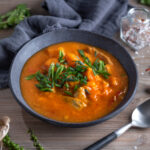
A profoundly flavoured Ethiopian red lentil stew built on a slow-cooked base of spiced clarified butter and caramelised onion, fired with berbere spice blend — bold, earthy, and deeply satisfying.
About This Recipe
Misir wot occupies a central place on the Ethiopian injera tray — one of the essential dishes in the communal eating tradition that defines the cuisine, where a shared platter of injera (the spongy sourdough flatbread) is covered with mounds of different stews, salads, and vegetables for everyone to eat from together. It is a dish of extraordinary depth, especially given that it is made from nothing more exotic than red lentils, onions, and spice.
The foundation of all Ethiopian wot (stewed dishes) is the niter kibbeh — Ethiopian spiced clarified butter, infused with onion, garlic, ginger, turmeric, cinnamon, cardamom, and fenugreek as it is clarified. This aromatic fat carries flavour through every molecule of the dish in a way that olive oil or regular butter cannot match. It can be made in advance and keeps for months in the fridge, used as a finishing fat for any number of Ethiopian dishes.
The other essential component is berbere — the complex Ethiopian spice blend that forms the backbone of the wot. Unlike most spice blends, berbere is not simply hot: it is layered and multidimensional, combining dried chillis with coriander, fenugreek, cinnamon, cardamom, bishop’s weed, and rue into something that tastes unlike any other spice mixture in the world. Pre-made berbere is available at Ethiopian grocery stores and online; making it from scratch produces a superior result. The onions must be cooked for a genuinely long time — 30–40 minutes — until they are a deeply caramelised, dark, sweet paste. This is not a step that can be rushed without cost to the finished dish.
History & Origins
Ethiopian cuisine is one of the oldest continuous culinary traditions in the world, and wot dishes appear in texts dating back centuries. Misir wot has particular significance in Ethiopian Orthodox Christianity, where the fasting calendar prohibits meat and dairy on over 200 days per year — making spiced lentil stews like misir wot a theological as well as culinary cornerstone. The prominence of vegetarian dishes in Ethiopian cuisine is thus rooted not in contemporary health trends but in ancient religious practice that has preserved and refined these dishes across generations.
Why It’s Healthy
Red lentils are one of the most nutritionally dense foods in the world — a single serving of misir wot provides approximately 18g of plant protein, 12g of fibre, and significant quantities of iron, folate, and potassium. The berbere spice blend is extraordinarily rich in antioxidants; chilli peppers in particular contain capsaicin, which has documented anti-inflammatory and metabolic benefits. Niter kibbeh, made from clarified butter, provides fat-soluble vitamins A, D, E, and K2. The combination of protein, fibre, and healthy fat makes misir wot an exceptionally satiating and nutritionally complete meal.
Calories: 320 kcal | Protein: 18g | Carbs: 46g | Fat: 8g | Fiber: 13g

Spiced Red Lentil Stew
4
servings30
minutes40
minutes300
kcalIngredients
•t300g red lentils, rinsed
•t2 very large onions, finely diced
•t5 garlic cloves, minced
•t2cm piece ginger, grated
•t3 tbsp berbere spice blend
•t2 tbsp niter kibbeh (Ethiopian spiced butter) or regular ghee
•t1 tbsp tomato paste
•t700ml water or vegetable broth
•tSalt to taste
•tFor niter kibbeh (simplified): 100g butter, 0.5 tsp turmeric, 0.5 tsp cinnamon, 0.5 tsp cardamom, 1 tbsp minced onion, 2 garlic cloves
Directions
- Make simplified niter kibbeh: melt butter with aromatics over low heat for 20 minutes. Strain through cheesecloth and cool. (Skip if using ghee.)
- Heat niter kibbeh in a large heavy pan over medium heat. Add onions and cook, stirring every few minutes, for 30–40 minutes until deeply caramelised and dark brown. Do not rush this step.
- Add garlic and ginger, cook 3 minutes.
- Add berbere and tomato paste. Stir and cook for 3 minutes until the spices darken and stick to the pan.
- Add rinsed lentils and water. Stir to combine, scraping up any spice paste from the bottom.
- Bring to a boil, then reduce to a low simmer. Cook uncovered for 20–25 minutes, stirring every 5 minutes, until lentils are completely dissolved and the stew is thick.
- Season generously with salt. The finished wot should be very thick — thicker than a soup, closer to a porridge.
Notes
- The 30–40 minutes of onion cooking is not negotiable. Pale, undercooked onions produce a flat, raw-tasting wot with none of the depth that makes the dish extraordinary.
Berbere spice blend is available at Ethiopian/Eritrean restaurants and grocery stores, and from online spice retailers. The quality varies enormously — find a brand made in Ethiopia if possible.
Misir wot is traditionally much spicier than this recipe — increase the berbere to 4–5 tablespoons if you want the authentic heat level.
The stew thickens dramatically as it cools — serve while still loose enough to spread on injera
Make Ahead Tips
Misir wot is one of the best make-ahead dishes in this collection — it improves significantly over 24–48 hours as the berbere flavours deepen and the lentils fully absorb the spiced butter. Make a large batch on the weekend and refrigerate for use throughout the week. The stew also freezes perfectly for up to 3 months, making it ideal for batch cooking.
Storage
Misir wot keeps in the fridge for up to 6 days — it is one of the most fridge-stable dishes in this book. The flavour genuinely improves day by day. Reheat over low to medium heat with a splash of water, stirring frequently. The stew will have thickened to an almost solid consistency when cold — this is normal, and it will loosen as it warms. Niter kibbeh keeps in the fridge for 3 months and in the freezer for a year.
Serving Tips
Serve on injera — the spongy Ethiopian sourdough flatbread that acts as both plate and utensil — alongside a raw vegetable salad (tikel gomen), a mild tomato salad (salata), and ideally other wot dishes for a full spread. If injera is unavailable, serve over rice or with thick flatbread. Ethiopian dining is communal — place a large piece of injera on a shared tray, spoon the misir wot over it, and eat by tearing pieces of injera to scoop up the stew.
Variations & Substitutions
Add a generous handful of spinach or collard greens in the final 5 minutes for extra nutrition and colour. For a richer version, stir in a tablespoon of tahini or peanut butter at the end of cooking. A small amount of finely chopped preserved lemon adds brightness that cuts through the intensity of the berbere. Some cooks add a handful of baby tomatoes in the last 10 minutes, which collapse into the stew and add a fresh, acidic note.