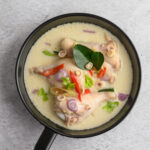
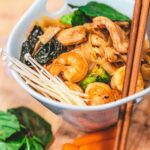
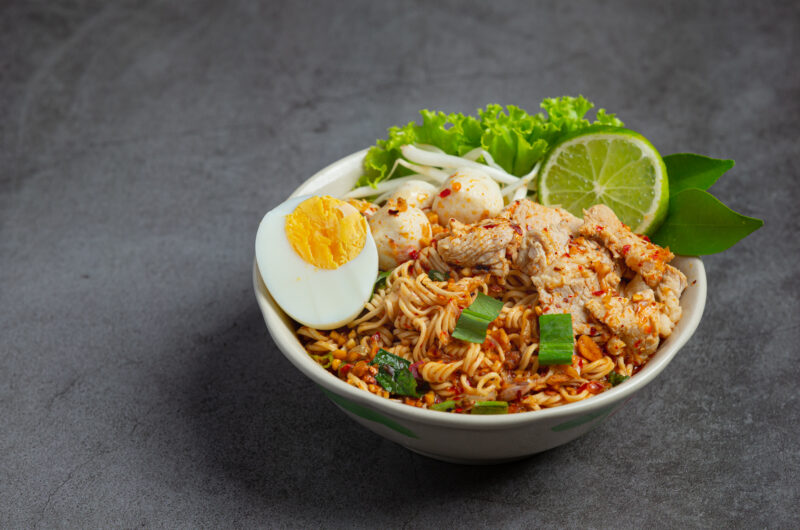
Myanmar’s beloved national breakfast — a silky, lemongrass-scented fish broth thickened with toasted rice powder and chickpea flour, poured over tender rice vermicelli and crowned with crispy fritters and hard-boiled egg.
About This Recipe
Mohinga is the soul of Burmese food — a dish so deeply embedded in the national identity that it is eaten at every hour of the day, from pre-dawn breakfast to late-night supper, from street carts to family tables, in every city and village across Myanmar. It is the dish that every Burmese person grows up eating, and the one most likely to provoke waves of homesickness in the diaspora.
The broth is the heart of the dish: a complex, layered base built from fish — traditionally catfish, though any firm white fish works well — simmered with lemongrass, ginger, and shallots, then thickened with toasted rice powder and chickpea flour into a texture that is opaque and slightly velvety, unlike any other fish broth in Southeast Asian cooking. The thickening agents are toasted separately until golden before being stirred into the broth, which adds a nutty, roasted dimension and creates the characteristic cloudy consistency that makes mohinga immediately recognisable.
Banana stem — the inner, tender core of the banana plant — is the traditional vegetable addition, providing a mild, slightly astringent flavour and a fibrous texture that contrasts beautifully with the silky broth. It is available at Asian supermarkets, though hearts of palm is a widely accepted substitute. The toppings are what make mohinga festive: split pea fritters, crispy onions, hard-boiled eggs, and fresh lime are arranged at the table so each person can customise their bowl to their own preference.
History & Origins
Mohinga’s origins are debated by food historians, but the dish has been part of Burmese culture for at least several hundred years, with references appearing in 19th-century Burmese literature. Unlike many national dishes that have clear origins in court or aristocratic cooking, mohinga has always been street food — the breakfast of labourers, traders, and schoolchildren alike. The unifying quality of a dish eaten by every social class and in every region of a diverse country has given it a symbolic importance beyond its culinary excellence.
Why It’s Healthy
Mohinga is a nutritionally impressive bowl. The fish provides lean protein and omega-3 fatty acids essential for cardiovascular and brain health. Chickpea flour adds plant-based protein and soluble fibre. Lemongrass and ginger contribute anti-inflammatory compounds, while the turmeric in the broth provides curcumin. Rice vermicelli offers a lower-GI carbohydrate base than wheat noodles. The soup’s substantial protein and fibre content means it keeps you satiated for hours — exactly what a working breakfast needs to achieve.
Fish Noodle Soup
4
servings30
minutes40
minutes300
kcalIngredients
•t400g firm white fish fillets (catfish, tilapia, or cod)
•t200g rice vermicelli noodles, soaked
•t400g banana stem or hearts of palm, sliced into rounds
•t3 stalks lemongrass, bruised and tied in a knot
•t6 shallots, thinly sliced
•t4 garlic cloves, minced
•t2cm piece ginger, minced
•t3 tbsp fish sauce
•t1 tsp turmeric
•t1 litre fish or chicken broth
•t3 tbsp toasted rice powder (blitz toasted jasmine rice)
•t3 tbsp chickpea flour, toasted in a dry pan
•t2 tbsp vegetable oil
•tFor garnish: 4 hard-boiled eggs, halved
•tFor garnish: crispy fried onions, fresh coriander, lime wedges, dried chilli flakes
Directions
- Simmer fish in the broth with lemongrass, half the shallots, and turmeric for 15 minutes. Remove fish and flake into large pieces. Discard lemongrass.
- Fry remaining shallots in oil until deeply golden and crispy. Add garlic and ginger, cook 2 minutes.
- Strain the fish broth and return to the pot. Add the shallot mixture.
- Whisk toasted rice powder and chickpea flour with 200ml cold water until smooth. Stir into the broth over medium heat.
- Simmer for 10 minutes, stirring frequently, until the broth is thickened and slightly opaque.
- Add banana stem or hearts of palm and cook for 5 minutes. Return flaked fish. Season with fish sauce.
- Cook soaked noodles in boiling water for 1 minute. Drain and divide into bowls.
- Ladle hot broth over noodles. Top with halved eggs and all garnishes. Serve with lime on the side.
Notes
- Toasted rice powder is made by dry-toasting raw jasmine rice in a pan until golden, then blitzing in a spice grinder. Make extra and keep in a jar — it keeps for months.
The broth must be stirred frequently as the rice powder and chickpea flour are added, or they will form lumps on the bottom of the pot.
Banana stem is available at Asian grocery stores — peel back the tough outer layers to reach the tender, pale inner core.
The soup base freezes well (without the noodles) — make a large batch of the broth and freeze in portions for quick weeknight meals.
Make Ahead Tips
The mohinga broth base can be made up to 2 days in advance and refrigerated, or frozen for up to 2 months. This makes the dish much more accessible as a weeknight meal — the bulk of the work is done in advance, and final assembly takes only 10 minutes. Prepare the garnishes the morning of serving. Noodles should always be cooked fresh.
Storage
The thickened broth keeps in the fridge for 3 days. It will continue to thicken on standing — thin with a little water or broth when reheating over medium heat, stirring frequently. Store fish and broth together. Noodles should be stored separately in cold water in the fridge and drained just before serving to prevent them from becoming gummy. The crispy fried onion garnish should be stored in a dry airtight container at room temperature and used within 3 days.
Serving Tips
Serve with the full garnish spread at the table — lime wedges, dried chilli flakes, fish sauce, and extra crispy onions. The lime is squeezed in just before eating and the chilli adjusted to taste. A small dish of fermented fish paste (ngapi) on the side is traditional and adds a deeply savoury, umami punch. Mohinga is traditionally eaten as breakfast but works beautifully as a light lunch or starter.
Variations & Substitutions
A vegetarian version can be made by replacing the fish with firm tofu and using vegetable broth — the thickened, spiced broth carries the dish remarkably well even without fish. Some Burmese cooks add a spoonful of peanut butter to the broth for extra richness and depth. In the Shan State style, the broth is thinner and served with tomato-based sambal alongside.