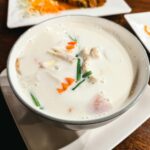
The celestial Thai coconut soup — tender chicken poached in a fragrant broth of galangal, lemongrass, and kaffir lime, enriched with coconut milk and balanced with fish sauce and lime juice into something simultaneously delicate and profound.
About This Recipe
Tom kha gai is one of the most elegant soups in the world — a preparation of apparent simplicity that achieves a flavour depth and aromatic complexity that takes the palate by surprise every time. The name translates as ‘galangal chicken soup’, and galangal — not lemongrass, not kaffir lime, not coconut milk, though all are essential — is the ingredient that defines the dish. Without galangal, you have a pleasant coconut soup. With it, you have tom kha gai.
Galangal is related to ginger but is a completely different ingredient in flavour and character — piney, citrusy, almost medicinal in its intensity, with a flavour that has been described as tasting like the smell of a Thai kitchen. It cannot be substituted by ginger, which is a milder, earthier, entirely different root. Large slices of galangal are added to the soup not to be eaten — they are too fibrous and intense — but to infuse the broth with their volatile aromatic oils during the poaching process. The kaffir lime leaves, torn to release their oils, and the bruised lemongrass serve the same purpose: they are flavouring agents in the broth, not ingredients in the eating.
The coconut milk is added in two stages: first, a generous pour into the hot broth to create the soup base, then a final addition of coconut cream just before serving to restore the fresh coconut fragrance and richness that is lost during prolonged heating. The fish sauce provides the salt, the lime juice provides the acidity, and the balance between the two — adjusted at the very last moment by the cook, tasting as they go — is the technical craft of the dish. The galangal, lemongrass, and kaffir lime leaves are left in the bowl as visual elements and aromatics; each diner learns quickly which pieces to eat around.
History & Origins
Tom kha gai appears in Thai culinary records from at least the 19th century, though its origins are likely older. The dish reflects the central role of coconut milk in Thai coastal cooking and the importance of the aromatic triangle of galangal, lemongrass, and kaffir lime that underpins much of Thai and wider Southeast Asian cuisine. Tom kha gai was included in the 1890 Thai culinary text Tamra Kap Khao — one of the earliest comprehensive Thai cookbooks — demonstrating its established status as a classic dish of the Thai culinary canon.
Why It’s Healthy
Galangal contains galangin and kaempferol — flavonoids with extensively studied anti-inflammatory and antioxidant properties. Research has also shown galangal extracts to have antimicrobial activity and potential benefits for digestion. Coconut milk provides lauric acid, a medium-chain saturated fat with documented antimicrobial properties that is metabolised differently from long-chain saturated fats. Kaffir lime leaf contains high concentrations of antioxidant flavonoids and volatile oils with anti-inflammatory properties. Lemongrass contains citral, a compound with antimicrobial and anxiolytic properties studied in clinical research. The chicken provides complete lean protein.
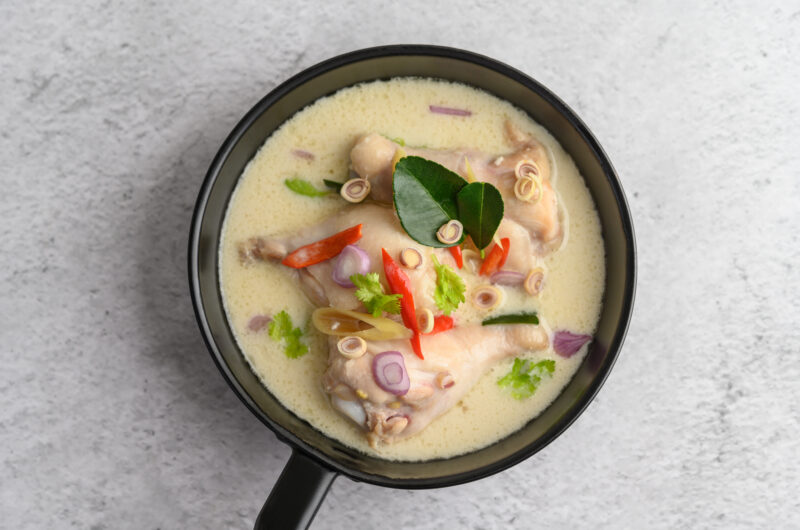
Coconut Galangal Chicken Soup
Course: Healthy, Soup, Thai4
servings20
minutes35
minutes1440
kcalIngredients
•t500g chicken thigh fillets, thinly sliced
•t400ml full-fat coconut milk
•t200ml chicken broth
•t6cm piece galangal, thinly sliced into rounds
•t3 stalks lemongrass, bruised and cut into 5cm pieces
•t8 kaffir lime leaves, torn
•t200g oyster or straw mushrooms, torn
•t3 tbsp fish sauce
•tJuice of 2 limes
•t1 tsp palm sugar or light brown sugar
•t3 bird’s eye chillies, bruised
•tFresh coriander leaves to garnish
•tExtra coconut cream to finish (optional)
Directions
- Combine broth, 300ml coconut milk, galangal, lemongrass, kaffir lime leaves, and chillies in a pot.
- Bring to a gentle simmer over medium heat. Simmer for 5 minutes to infuse aromatics.
- Add chicken and mushrooms. Poach gently for 8–10 minutes until chicken is just cooked through.
- Season with fish sauce, lime juice, and palm sugar. Taste and adjust — the balance of salty, sour, and sweet should be harmonious.
- Stir in remaining coconut milk and heat for 1 minute.
- Ladle into bowls. Add a spoonful of coconut cream on top if using.
- Garnish generously with fresh coriander. Serve immediately.
Notes
- Do not boil the soup vigorously after the coconut milk is added — it can separate. Maintain a gentle simmer throughout.
Galangal is available at Asian grocery stores. It is not interchangeable with ginger — the flavours are completely different. Do not substitute.
The aromatic solids (galangal, lemongrass, lime leaves) are not eaten — they are in the bowl for fragrance only. Diners eat around them.
The final balance of fish sauce (salt) and lime juice (acid) is where the cook’s palate is expressed — taste and adjust until the soup sings.
Make Ahead Tips
The aromatic broth base (galangal, lemongrass, kaffir lime infused in broth) can be made up to 2 days in advance and refrigerated, or frozen for 2 months. The aromatic infusion actually deepens overnight, producing a more fragrant base. Add the coconut milk and chicken fresh at cooking time. The soup takes only 15 minutes to complete from the pre-made broth base.
Storage & Serving
Tom kha gai is best eaten the day it is made — the coconut milk can separate slightly on reheating and the delicate aromatics fade in the fridge. If storing, refrigerate for up to 2 days and reheat very gently over low heat without boiling. The soup will taste good but the freshness of the aromatics will be diminished. For the best results, make the aromatic broth ahead and finish with chicken and coconut milk fresh. The dish does not freeze well once the coconut milk is added. Serve in deep bowls with steamed jasmine rice alongside, allowing each person to add rice to their soup bowl in the Thai style. A plate of fresh coriander, sliced red chilli, and extra lime wedges at the table allows customisation. Tom kha gai is traditionally a starter in Thai multi-course meals but serves equally well as a light main course. A cold Thai iced tea or cold Singha lager are the traditional accompaniments.
Variations & Substitutions
Tom kha het is the equally popular mushroom version — replace the chicken with a variety of mushrooms (shiitake, oyster, enoki) for a deeply flavoured, fully vegan soup that is extraordinary in its own right. Tom kha pla uses firm white fish fillets, added in the final 5 minutes, for a lighter, more delicate version. A richer version adds a tablespoon of roasted chilli paste (nam prik pao) to the broth base for depth and a subtle smokiness that is popular in Thai restaurants. Tofu and courgette in place of chicken makes a satisfying vegetarian version.