Pure, golden, melt-in-the-mouth Scottish shortbread with just three ingredients — the simplest cookie recipe you will ever make and one of the best things you can pull from an oven.
About This Recipe
Shortbread is the purest expression of what a cookie can be. Three ingredients — butter, sugar, flour — combined in the simplest possible way and baked until just golden. No eggs, no leavening, no flavourings beyond the butter itself. The magic is entirely in the quality of the butter and the technique, both of which reward attention and punish carelessness.
The butter must be good and it must be at the correct temperature. Too cold and it will not cream properly, producing a dense, crumbly shortbread. Too warm and the dough will be greasy and the finished cookies will spread and lose their shape. The ideal is soft enough to press with a finger but cool enough that it still holds its shape — described in most Scottish baking recipes as cool room temperature.
The flour is worked into the butter mixture until the dough just comes together. The moment it forms a cohesive mass without crumbling is the moment to stop. Overmixed shortbread develops gluten and loses the characteristic crumble that defines the best version. The dough is pressed into a tin or rolled and cut into fingers, baked at a low temperature that dries rather than browns the shortbread, and then cut while still warm — once cooled it becomes brittle and shatters under a knife.
History & Origins
Shortbread has been made in Scotland since at least the 12th century, when it evolved from a medieval biscuit bread. Mary Queen of Scots is documented to have been particularly fond of shortbread in the 16th century. The association between shortbread and Scotland is so strong that it has become one of the most enduring symbols of Scottish food culture, exported worldwide in decorative tins and served at Hogmanay celebrations as a traditional gift to neighbours.
Why It’s Easy To Make
Three ingredients. No equipment beyond a bowl and a tin. Virtually impossible to fail. The most beginner-friendly bake in this collection.
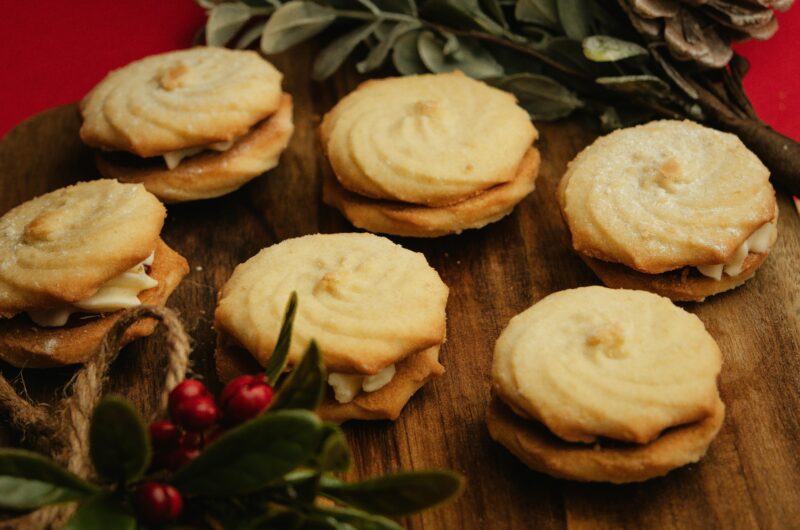
Buttery Shortbread Fingers
Course: Baking, Cookies16
servings10
minutes25
minutes2240
kcalIngredients
•t225g unsalted butter, cool room temperature
•t100g icing sugar, sifted
•t300g plain flour
•tPinch of salt
•tExtra caster sugar for sprinkling
Directions
- Preheat oven to 160°C. Lightly grease a 20x30cm baking tin or line with paper.
- Beat butter and icing sugar together until just combined and smooth. Do not overbeat.
- Add flour and salt. Mix until the dough just comes together into a smooth mass.
- Press dough evenly into the prepared tin to about 1cm thickness.
- Prick all over with a fork in a regular pattern.
- Bake for 20 to 25 minutes until pale golden. The edges should be just beginning to colour.
- Immediately cut into fingers while still warm and soft.
- Sprinkle with caster sugar. Leave to cool completely in the tin before removing.
Notes
- Cut while warm — shortbread is impossible to cut cleanly once it has cooled and hardened.
The fork pricking is not decorative. It prevents the shortbread from puffing and cracking during baking.
Low and slow is the key — shortbread baked at too high a temperature browns before it dries through properly.
Press the dough firmly and evenly into the tin for consistent thickness and even baking.
Make Ahead Tips
Raw dough keeps wrapped in the fridge for 3 days. Baked shortbread keeps in a tin at room temperature for 2 weeks, making it ideal for gifts and advance baking.
Storage & Serving
Shortbread keeps in an airtight tin at room temperature for up to 2 weeks, making it one of the longest-lasting baked goods in this collection. Store in a single layer or with baking paper between layers to prevent breaking. The flavour actually improves over the first 2 to 3 days as it settles. Shortbread freezes well for 3 months. Package in cellophane bags tied with ribbon for an excellent homemade gift.
Variations & Substitutions
Add 1 tsp vanilla extract or the zest of a lemon to the dough. Press half a glace cherry into the centre of each finger before baking for a traditional Scottish finish. Dip cooled shortbread fingers halfway into melted dark chocolate for a more indulgent version. Add 2 tbsp of lavender sugar for an aromatic, floral shortbread that pairs beautifully with afternoon tea.