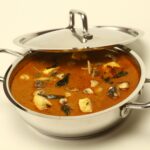
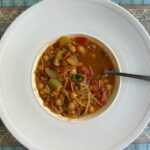
Korea’s deeply comforting, ancient soybean paste stew — bubbling with tofu, zucchini, mushrooms, and potato in a pungent, umami-rich doenjang broth that is one of the most flavourful things achievable with minimal effort.
About This Recipe
Doenjang jjigae is a dish that divides people unfamiliar with Korean food on first encounter and converts them completely on second. The doenjang — fermented soybean paste aged in earthenware crocks, sometimes for years — has an intensity and complexity that can seem overwhelming before you understand it: pungent, earthy, funky, and deeply savoury in a way that is unlike miso despite their shared fermented soybean ancestry. But in the context of the stew, tempered by the clean broth and the mild vegetables, it becomes something balanced and profoundly nourishing.
Doenjang jjigae is arguably the most important everyday dish in Korean home cooking — present at most meals, made in a hundred personal variations, the dish most associated in Korean culture with the warmth of a mother’s cooking and the comfort of home. It is made in a small stone pot (ttukbaegi) that retains heat and continues to bubble at the table, the aggressive boiling considered not just acceptable but desirable — unlike Japanese miso soup, Korean doenjang jjigae is intentionally boiled vigorously, which develops the flavour rather than destroying it.
The ingredients are minimal and flexible: tofu, zucchini (courgette), mushrooms, and potato are the classic combination, though the dish accepts almost any vegetable. Dried anchovies and kombu form the traditional stock (myeolchi yuksu), providing a seafood depth that works with the doenjang without competing with it. A small amount of gochugaru (Korean red pepper flakes) and sesame oil added at the end round out the flavour with gentle heat and nuttiness.
History & Origins
Doenjang has been produced in Korea for over 2,000 years, with historical records from the Three Kingdoms period (57 BCE–668 CE) documenting its production and trade. The fermentation of soybeans into pastes and sauces is one of the most ancient and universal food preservation technologies in East Asia, and the Korean tradition has developed distinct methods and flavour profiles that differ significantly from Chinese doubanjiang or Japanese miso. Doenjang jjigae appears in Korean royal court cuisine records from the Joseon dynasty, illustrating that despite its humble, everyday character, it has been eaten across all social classes.
Why It’s Healthy
Doenjang is one of the most comprehensively studied fermented foods. Korean research has identified unique bioactive peptides produced during doenjang’s long fermentation that have demonstrated anti-obesity, anti-cancer, and anti-inflammatory properties in laboratory studies. Unlike Japanese miso, doenjang is not heat-treated before consumption and retains a much higher concentration of live cultures and bioactive compounds. Tofu provides complete plant protein. Zucchini provides vitamin C, potassium, and lutein. The kelp and dried anchovy broth provides iodine, calcium, and omega-3 fatty acids. This is genuinely one of the most health-positive dishes in any cuisine.
Korean Doenjang Jjigae
Course: Healthy, Korean2
servings10
minutes20
minutes255
kcalIngredients
•t300g firm tofu, cubed
•t1 medium zucchini (courgette), sliced into half-moons
•t1 medium potato, cubed
•t100g shiitake or oyster mushrooms, sliced
•t3 tbsp doenjang (Korean fermented soybean paste)
•t1 tbsp gochugaru (Korean red pepper flakes)
•t3 garlic cloves, minced
•t1 tsp sesame oil
•tFor broth: 600ml water
•tFor broth: 5g dried kombu
•tFor broth: 20g dried anchovies (myeolchi), heads removed
•t1 spring onion, sliced, to garnish
Directions
- Make broth: combine water, kombu, and dried anchovies in a pot. Bring to a boil, reduce heat and simmer for 10 minutes. Remove kombu and anchovies. (Or use plain water for a milder, vegan version.)
- Bring broth to a vigorous boil. Add doenjang and stir until fully dissolved.
- Add potato and cook for 5 minutes.
- Add tofu, zucchini, and mushrooms. Continue boiling for 8 minutes.
- Add garlic and gochugaru. Cook for a further 3 minutes.
- Taste and adjust with more doenjang if needed — the stew should taste pungent and savoury.
- Stir in sesame oil. Serve immediately in the pot, garnished with spring onion.
Notes
- Doenjang jjigae is meant to boil aggressively — this is correct and traditional. Do not reduce to a gentle simmer.
Doenjang is available at Korean grocery stores and online. Korean doenjang has a distinctly different, more intense flavour than Japanese miso — they are not interchangeable.
The stew continues to cook at the table if served in a stone pot — account for this and undercook slightly.
Make Ahead Tips
The dried anchovy and kombu broth can be made up to 3 days in advance and refrigerated, or frozen for 2 months. The doenjang base (broth with paste dissolved) can be made ahead and kept for 2 days. Final assembly with the vegetables and tofu should be done at time of serving — the vegetables and tofu take only 15 minutes from start to finish.
Storage
Doenjang jjigae keeps in the fridge for up to 3 days. The tofu absorbs the intense broth and the stew becomes even more flavourful on the second day. Reheat vigorously — bring back to a full boil, which is how the dish is traditionally served. The potato and zucchini soften considerably on storage; if texture is important, use less of both and add fresh cooked vegetables when reheating. The stew does not freeze well due to the tofu and vegetable textures.
Serving Tips
Serve in a stone pot (ttukbaegi) placed directly on a trivet at the centre of the table, still bubbling, alongside bowls of steamed short-grain rice. In Korean table settings, the jjigae is a shared dish eaten communally with rice and several small side dishes (banchan) — at minimum, kimchi and a simple namul (seasoned vegetable) on the side. Each person takes a spoonful of jjigae and a bite of rice alternately, never mixing the two in the bowl.
Variations & Substitutions
Add 100g of Korean sausage (sundae) or sliced pork belly for a non-vegetarian version that is traditional in many Korean households. Replace tofu with clams, mussels, or prawns for a seafood variation (haemul doenjang jjigae) that is particularly popular in coastal areas. For a richer, restaurant-style version, add a tablespoon of gochujang alongside the doenjang and a drizzle of perilla oil instead of sesame oil at the end.